
How Australia Post has become part of my life
We talk about transport of people a lot but what about the transport of goods like my book? That's also part of the fabric of community life.

The postie path has always been a big part of my approach to verge gardening. That’s not just making sure they can get to the postbox; it’s creating a path that shows that you anticipate and welcome their use of that space.
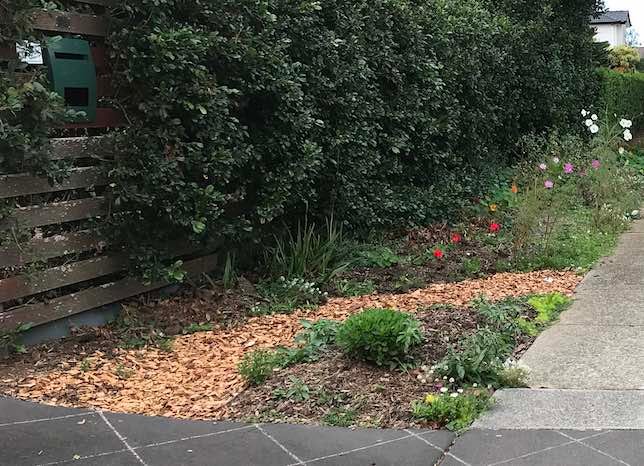
By chance when they were recording the Gardening Australia episode, the postman came by. You can see he makes his appearance in the video at about the 2:23 mark.
We published the first book, Garden on the Verge, as print-on-demand with IngramSpark. They sell direct to bookshops and library distributors. I have the option to order in any quantity and sell them direct—not a garage full of dusty books but a small box of books delivered by Australia Post as I need them. But did I really want to become a bookseller?
Setting up the technical side was fairly easy, hooking together Payhip, Stripe, and PayPal—with Bookfunnel for the e-books. But delivery? Couriers? Australia Post? As someone who had not posted a letter or parcel for decades, I had no idea where to start but I did know that I wanted tracking. Time for a visit to the local post office.
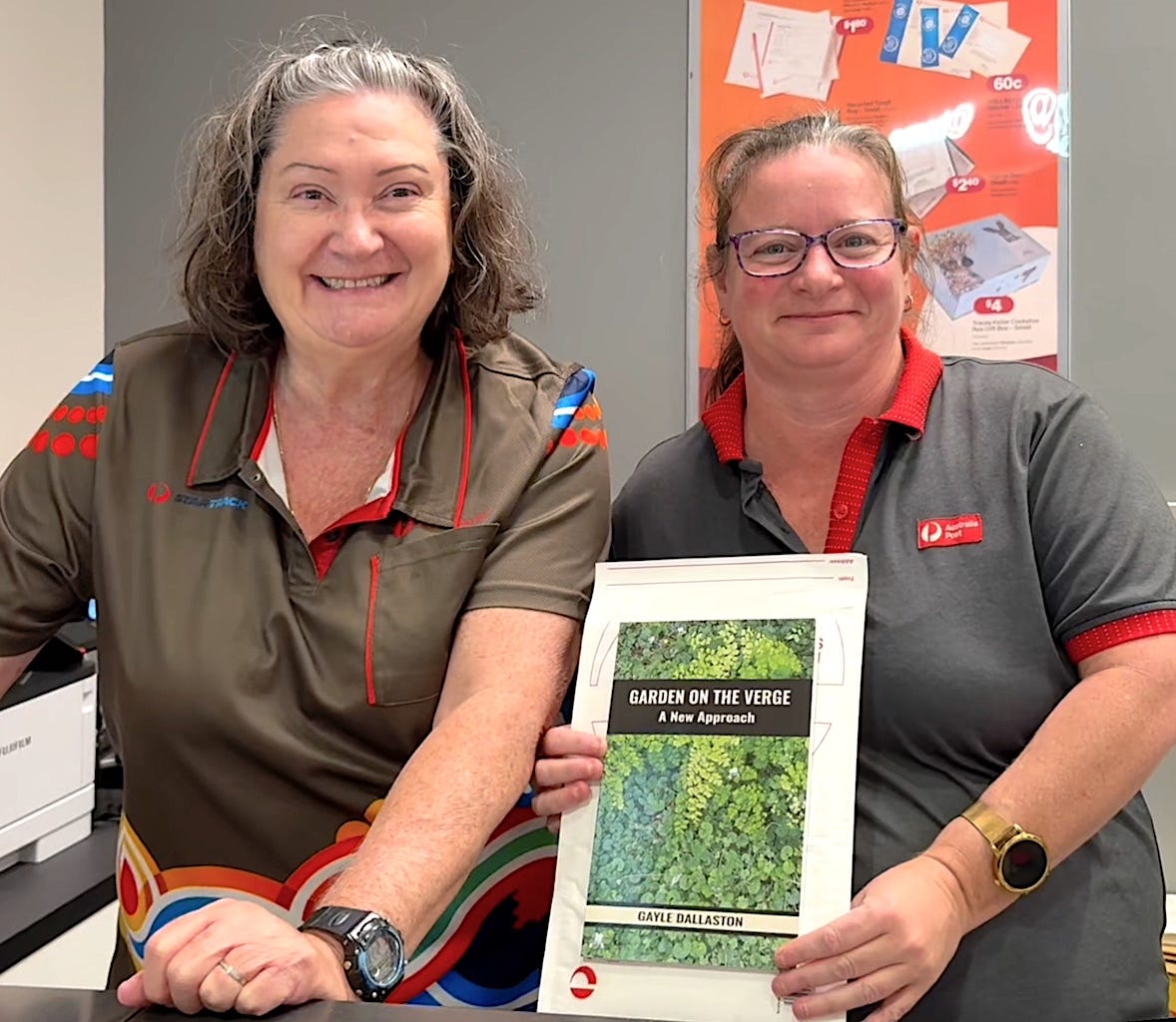
Postal Leader, Rebecca soon had me sorted out with a MyPost Business Account, and padded envelopes that fitted the book perfectly. None of my clumsy wrapping or messy handwriting.
This is the routine…
When an order comes in, I enter the details in the MyPost Dashboard. It verifies the address, and gives the options for tracking, parcel size, and standard or express post. At the end of the day, I pay the postage with my stored credit card. Then I slip the books into the envelopes ready for the post office.
I can walk to the post office if I want the exercise. Otherwise, I have a short bus ride there and back. (50c for most people thanks to the Queensland Government, free during non-peak hours for people of my age thanks to Brisbane City Council)
The counter staff scan the QR code on my phone and print the labels for each item. So easy, and I get a receipt to show it is now on its journey. Tracking is in motion. (There are options to print labels yourself and for posting or pickup.)
The final step is to log into Payhip, add the tracking code and mark each order as shipped. Payhip sends an email to the book buyer to let them know. The Australia Post tracking means we can both see where the parcels are on the journey. Payhip alerts me when there’s an order and produces reports for our accounting system.
Systems, Automation, and People
Perhaps it’s my background but I get a bit of a buzz when automated technical systems work well. In their place, they make life much easier and do routine jobs more efficiently than people. But they have their limits.
The people in this story, the posties who deliver the mail, the team at the local Australia Post shop, even the bus driver, all play parts better done by humans. These roles and the people who play them are a core part of networked communities, liveable cities, and sustainable economies.
Transport Choices
We talk about transport of people a lot but what about the transport of goods?
Do we want a linear supply chain controlled by international corporations that turn books, authors, and delivery workers into just another commodity — and turn book buyers into passive consumers? Or do we support a system with a network of businesses, organisations and people who are part of a thriving local economy.
I took the self-publishing route because it was much faster. It also means I can choose how my books are printed and distributed.
There are 4 ways readers can get the printed book:
borrow from their local library - who get the book through library distributors;
order from their local bookstore - who get the book direct from Ingram Spark /Lightning Source as print-on-demand in the relevant country;
buy from me online with delivery by Australia Post (AU only);
buy from reputable online bookstores like Booktopia who support the local publishing industry and who also deliver via Australia Post.
Using Australia Post means supporting an organisation that:
provides opportunities for community connections. Seeing the same faces brings life to our streets and shopping centres.
consolidates delivery within suburbs so its more efficient and sustainable. We really don’t need immediate delivery of everything.
increases safety on our streets - compare a postie on a bike to a delivery driver rushing to meet tight deadlines in a car or van.
creates stable employment with career paths and rights.
Networks and Economies
When we talk about sustainability, we tend to do it in bubbles. Yes, a verge garden is good for the environment, but it’s only when it is part of the urban green corridors that its value for biodiversity escalates. That’s still a narrow, linear view of how we can work towards a better future. We widen that view a bit when we add in the social and health benefits of cooler, walkable streets.
Too often, we hear environment and economy treated as disconnected or opposing forces. Jobs versus environment, housing developments versus trees. The Sustainable Development Goals (SDGs) allow us to focus on the goals we want to address and ignore the others.
However, just as we can choose between barren verges and biodiverse verge gardens, we can choose how we see and measure our economies.
Doughnut Economics reframes the SDGs into a circle of interlinking issues where we need to address all issues - or at least not make one better at the detriment of others. For people to thrive, we need to nurture an economy that addresses environmental and social issues. That’s much harder to imagine and implement.
This is our challenge when we talk about Circular Economies. Businesses can’t become circular alone; they need a network with complementary business models, systems, and technology to support it. For small businesses with physical products like mine, Australia Post is an essential part of that network.
What’s this got to do with Verge Gardens?
The qualities of verge gardens as local, connecting, contested spaces, provide a place and activity that helps us see the world from new angles. That’s key to finding new ways of collaborating to address complex problems at all levels.
A verge garden is the first step that is doable. The stance I advocate in this book and the free Understanding the Space articles prepares you for the next steps of group projects, networks, and collaboration.


